
I have been obsessed with Apple TV’s Silo since the first episode dropped. Not because of the dystopian mystery — though that’s gripping — but because the show treats engineering as the backbone of survival rather than a plot convenience.

Juliette Nichols isn’t a superhero. She’s a mechanical engineer who fixes steam turbines, and that choice changes everything about how the story works.
With Silo season 3 premiering on July 3, 2026, and a split timeline promising to reveal how the silos were built in the first place, I wanted to dig into the real engineering and technology behind this underground world. How much of what we see on screen actually holds up against real-world science?
Turns out, quite a lot — and the places where it breaks down are just as fascinating.
What Is the Silo?
The Silo is a 144-level underground megastructure housing roughly 10,000 people in a self-contained, closed-loop habitat. It functions as a vertical city with its own power generation, food production, air management, and governance systems — all sealed off from a toxic surface world.
The concept draws from real engineering challenges that nuclear submarine designers, space station architects, and bunker engineers have grappled with for decades. But Silo pushes the scale far beyond anything we’ve actually built.
Power Generation — The Steam Turbine in the Basement
The entire silo runs on a single steam turbine buried in the mechanical levels at the bottom. This is one of the show’s most grounded engineering choices. Geothermal energy — tapping heat from deep underground — is a real and proven power source.
Iceland generates nearly 25% of its electricity from geothermal plants. The principle is straightforward: heat from the Earth’s core turns water into steam, steam spins a turbine, the turbine generates electricity. No fuel deliveries required.
But here’s where the math gets uncomfortable. One analysis estimated that growing enough food for 10,000 people using LED lighting across multiple farming levels would require roughly 700 megawatts of power. That’s the output of a small nuclear power plant, not a single steam turbine. A typical geothermal well produces between 5 and 50 megawatts.
So either the silo’s geothermal source is extraordinarily powerful, or the show is quietly hand-waving a significant energy gap. I suspect the “Before Times” timeline in season 3 might address this — perhaps the original builders had access to technology we don’t see in the present-day silo.
Suggested Reading: Spider-Man Brand New Day – What To Expect From The Upcoming Movie
Air Management — Breathing Underground Without Dying
This is the engineering challenge that would keep me up at night. Ten thousand people exhale roughly 4 tons of CO2 annually. Without active scrubbing, the air inside the silo would become toxic within weeks.
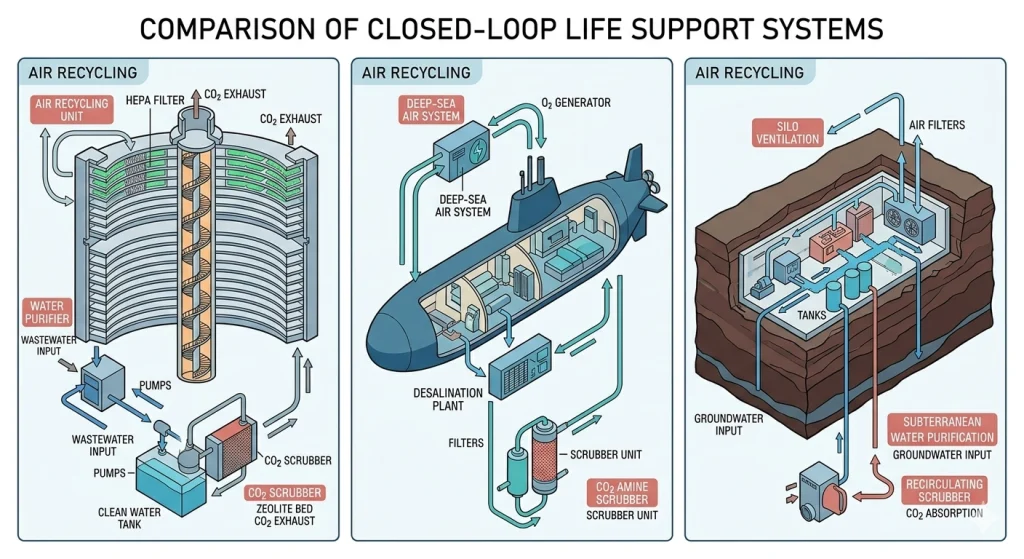
The real-world parallel here is the International Space Station. ESA’s Advanced Closed Loop System uses amine beads to trap CO2 from cabin air, then processes it through a Sabatier reactor — combining hydrogen and CO2 over a catalyst to produce water and methane. The system recovers about 50% of the water needed for oxygen production, saving approximately 400 litres of water per year that would otherwise need to be launched from Earth.
Now scale that to 10,000 people instead of six astronauts. The engineering complexity multiplies enormously.
Nuclear submarines offer another comparison. A US Navy submarine supports around 150 crew members in a sealed environment for months using electrolysis to split seawater into oxygen and hydrogen, plus chemical scrubbers for CO2. But even submarines surface periodically and can refresh their air supply. The silo never gets that luxury.
There’s also the oxygen-steel problem. Over decades, exposed steel and concrete inside the silo would slowly bond with oxygen through oxidation, gradually depleting breathable air in ways that are difficult to detect and nearly impossible to reverse. The show hints at this kind of slow degradation without naming it explicitly.
Food Production — Vertical Farming at an Impossible Scale
The silo dedicates multiple levels to agriculture, and this is where the show’s ambition collides hardest with physics. Growing food underground means replacing sunlight entirely with artificial lighting.
Modern vertical farms use LED grow lights tuned to specific wavelengths that plants absorb most efficiently — primarily red and blue light. Companies like Plenty and AeroFarms have demonstrated commercial-scale indoor farming. But they operate with grid power, supply chains for nutrients, and the ability to vent heat externally.
Inside a sealed silo, every watt of LED lighting becomes waste heat that has to go somewhere. One calculation puts this at 500 megawatts of thermal energy from lighting alone — enough to raise the temperature of the silo’s air from 21°C to 65°C in about an hour. Without massive heat dissipation systems, the farming levels would cook the residents below them.
Real closed-environment experiments have struggled with exactly this problem. Biosphere 2, the famous sealed ecosystem experiment in Arizona, couldn’t grow enough food for eight people. Oxygen levels dropped mysteriously. The concrete absorbed CO2. Crops failed. If we couldn’t sustain eight people in a glass dome with natural sunlight, feeding 10,000 underground is a staggering engineering challenge.
The show wisely keeps the farming levels mostly in the background, which is probably the smartest production decision they made.
Suggested Reading: All Time Best War Movies Which You Should Have Watched
Water Recycling — Every Drop Counts
A closed-loop water system is non-negotiable underground. Every drop of water in the silo has to cycle endlessly — from drinking water to wastewater to purified water and back again.
The ISS already does this. NASA’s Water Recovery System reclaims water from humidity, urine, and even crew sweat, producing drinking water that astronauts describe as cleaner than most municipal tap water. The process uses vapour compression distillation followed by catalytic oxidation to break down contaminants.
For 10,000 people, the scale is different but the principle holds. Modern wastewater treatment plants handle this daily for entire cities. The real engineering question in the silo isn’t whether water recycling is possible — it’s maintenance. Filters degrade. Membranes clog. Pumps wear out. Without a supply chain for replacement parts, every component has a finite lifespan.
This connects to something the show does brilliantly. The constant tension between Mechanical and Supply isn’t just political drama — it reflects a genuine engineering reality. In any closed system, the people who maintain the infrastructure hold the real power.
Structural Engineering — Building 144 Levels Deep
Let’s talk about the structure itself. A 144-level underground cylinder is an extraordinary feat of civil engineering, and the show doesn’t shy away from the physical reality of it.
The deepest building currently in existence is the Syväoja mine in Finland, reaching about 1,400 metres below surface. Modern deep mines routinely operate at 2,000+ metres. So the depth isn’t inherently impossible — we can dig that far.
But a mine shaft and a habitable 144-level building are fundamentally different problems. The silo needs to handle:
- Lateral earth pressure — surrounding rock and soil push inward on the cylindrical wall, increasing with depth
- Thermal gradients — temperatures rise roughly 25°C per kilometre of depth, meaning the bottom levels could be 30–40°C warmer than the top
- Seismic resilience — even moderate earthquakes would stress a rigid structure spanning that much vertical distance
- Vibration isolation — 10,000 people walking, machinery running, water flowing — all transmitting through a single connected structure
The spiral staircase that connects all 144 levels is arguably the most iconic visual element of the show. From an engineering standpoint, it serves as the silo’s spine — structurally tying the levels together while providing the only mass transit route. No elevators in the show. Just stairs. I’d skip leg day living there.
Suggested Reading: Best Ture Crime Sows of All Time Which You Must Watch
Surveillance and Social Control — The Tech You Don’t See
This is the angle most engineering analyses of Silo overlook, and it’s the one that should resonate most with tech professionals.
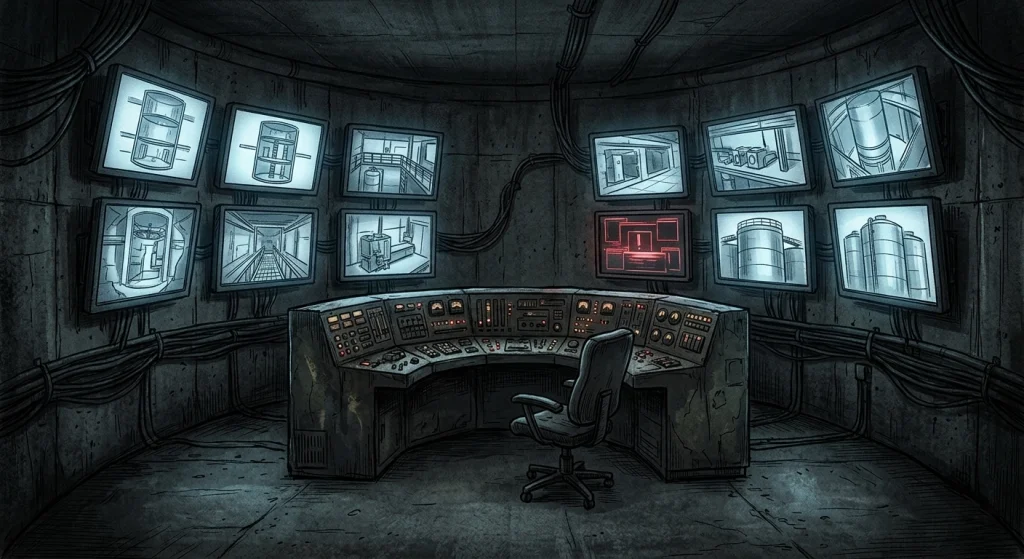
The silo’s governance depends on information control. Cameras monitor public spaces. The IT department manages what knowledge is accessible. The Pact — the silo’s governing document — restricts access to historical records, certain books, and any information about the outside world.
Compare this to real-world surveillance infrastructure. Modern cities deploy thousands of cameras with facial recognition capabilities. China’s social credit system monitors citizens’ behaviour and restricts access to services based on compliance scores. The silo’s system is cruder — it relies on social pressure and physical enforcement rather than algorithmic scoring — but the architecture is recognisable.
For developers and tech professionals, the show raises uncomfortable questions. Who controls the information systems? What happens when the people maintaining the infrastructure discover that the data they’re protecting is a lie? Season 2 explored this directly through the IT department’s discovery of hidden files, and I expect season 3 to push even further.
The most chilling piece of silo technology is the Safeguard system — essentially a kill switch that can flood the entire structure with poison. An AI system called “the Algorithm” controls it. We build automated fail-safes into real critical infrastructure too. Nuclear power plants have SCRAM systems. Data centres have automated fire suppression. The question Silo asks is: what happens when the fail-safe is designed to protect the system rather than the people inside it?
Communication Systems — Signals Through Stone
The silo uses a wired communication network — hardline phones and intercom systems rather than wireless. This is actually more realistic than it might seem.
Radio signals struggle underground. Rock, concrete, and earth attenuate wireless frequencies rapidly. Real mines use leaky feeder cables — coaxial cables with slots cut into the outer conductor that allow radio signals to leak out along their length, creating a linear antenna through tunnels. Even with modern technology, reliable wireless communication in deep underground structures requires extensive infrastructure.
The silo’s reliance on physical cables and runners carrying messages isn’t primitive — it’s pragmatic. And it serves a dual purpose narratively: controlling communication channels helps maintain the information monopoly that keeps the social order intact.
What Season 3’s “Before Times” Might Reveal
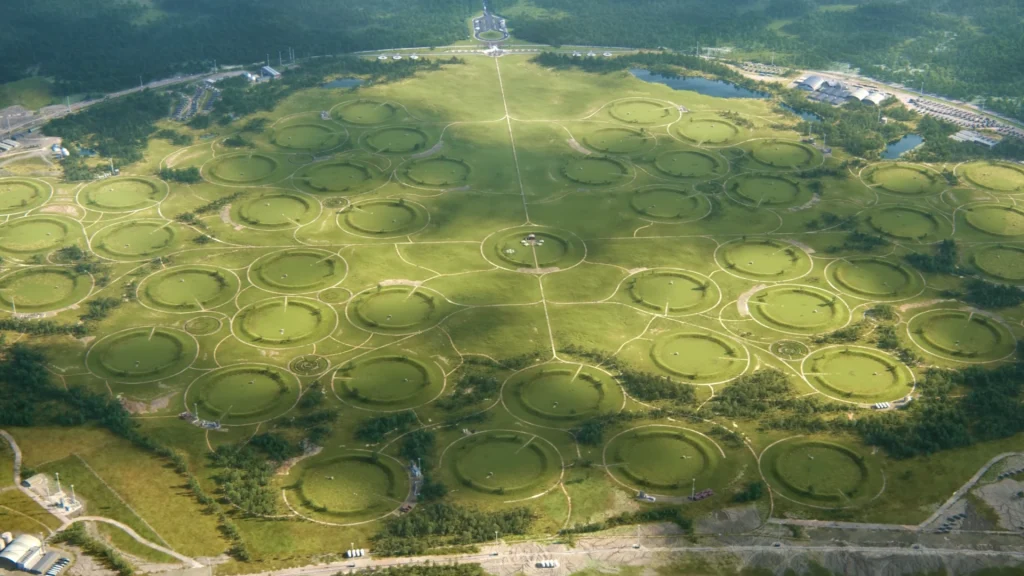
The split timeline confirmed for season 3 is what I’m most excited about from an engineering perspective. We’re going to see how the silos were conceived and built — the original engineering decisions, the compromises, and presumably the reasons certain systems were designed the way they were.
Real-world bunker construction for continuity-of-government programs has a fascinating history. The Greenbrier bunker in West Virginia was built in the 1950s beneath a luxury resort, designed to house the entire US Congress in the event of nuclear war. Cheyenne Mountain, carved inside a Colorado mountain, houses NORAD behind 25-ton blast doors. These were built with the technology of their era and designed for occupancy periods of weeks to months, not centuries.
Building something designed to sustain 10,000 people for hundreds of years requires a completely different engineering philosophy. Every system needs to be maintainable without external supply chains. Every material needs to last — or be replaceable using only what’s available inside the silo. That’s a design constraint that makes Mars colonisation look straightforward by comparison.
Suggested Reading: Best Movies That Defined and Conquered the 2010’s Decade
The Real Engineering Lesson From Silo
What makes Silo work as a show — and what should resonate with anyone who builds systems for a living — is that the technology is never the villain. People are. The silo’s engineering is brilliant. The power systems work. The air stays breathable. The water is clean. The structure holds.
The failure is always in governance, information control, and the decisions humans make about who gets to know the truth. If you’ve ever worked on a system where the technical architecture was sound but organisational politics made it dangerous, you’ll recognise the silo immediately.
Season 3 premieres July 3, 2026 on Apple TV+, with new episodes every Friday through September 4. I’ll be watching as both a fan and someone who can’t stop calculating whether the steam turbine output actually adds up.
Frequently Asked Questions
How realistic is the engineering in Apple TV’s Silo?
The engineering in Silo is grounded in real principles — geothermal power, closed-loop water recycling, and mechanical life support systems all have real-world counterparts on the ISS and in nuclear submarines. The main departure from reality is scale. Supporting 10,000 people in a sealed environment for centuries pushes every system far beyond what current technology has demonstrated.
Could a real underground silo sustain 10,000 people?
Sustaining 10,000 people underground is theoretically possible but practically extreme. The biggest obstacles are power generation for food production (estimated at 700 megawatts for LED farming alone), heat dissipation from artificial lighting, and long-term maintenance of life support equipment without external supply chains. Biosphere 2 couldn’t sustain eight people in far more favourable conditions.
What real-world technology is closest to the Silo’s life support systems?
Nuclear submarines and the International Space Station use the closest real-world equivalents. The ISS Advanced Closed Loop System recycles CO2 into water and oxygen using amine-based carbon capture and Sabatier reactors. Submarines use electrolysis and chemical scrubbers. Both support far fewer people than the silo’s 10,000, and both rely on periodic resupply.
When does Silo season 3 premiere?
Silo season 3 premieres on July 3, 2026 on Apple TV+, with 10 episodes releasing weekly every Friday through September 4, 2026. The season features a split timeline exploring both the present-day silo and the “Before Times” when the silos were originally conceived and built.
What new technology might Silo season 3 explore?
Silo season 3’s “Before Times” timeline is expected to reveal the original engineering and technology behind the silo’s construction — including the AI governance system known as “the Algorithm” and the Safeguard kill-switch mechanism. The prequel storyline should answer how the builders designed systems meant to sustain life for centuries without external support.


